Thursday, 30 July 2015

Focusing on flowers


Wherever I am I stop to see and smell the flowers. Here are a few blooms I have kept to enjoy later.

Flower stall in Utrecht, Netherlands. 

Wildflowers have been a source of pleasure from childhood when I learned their names from my mother. 

Marsh marigolds are spring wildflowers in Alberta.

Flower gardens have been important to my mother, grandmother and many other family members.
  
Delphiniums and lilacs were in my grandmother's garden.

I have had my own flower gardens in many locations.

My Edmonton container garden.


Fragrant frangipanis grew in my garden in Fujairah, United Arab Emirates. 

 Jacaranda.
Since retiring I have been fortunate to spend at least part of each Canadian winter some place warm, where each day I could see and smell flowers outdoors.

Water lilies.

Edmonton's Muttart
Conservatory.
While still living and working full time in Canada, I took many flower photographs in the summer to make a slideshow for my computer during the winter months. Occasionally in winter I would seek a mental health break in a conservatory or a garden centre that stayed open all year.


Rotorua, New Zealand


Elaborate gardens
One of Mum's roses


Spectacular Hydrangeas 


Single blooms


Temperate


Australian bottle brush. 


Tropical


Indoors and outdoors
Underground garden
Arras, France


Planters in Orleans, France. 

Cultivated flowers, native flowers and even flowering weeds.

Brilliant blue morning glories take over abandoned Melbourne house.

I love them all and believe that flowers contribute greatly to our emotional well-being.


Azaleas at Bargany Gardens, Ayrshire, Scotland. 

Monday, 13 July 2015

Discovering local history

A horse drawn wagon tour gave insights into the history of Edmonton's Beverly community. 

Here in the Edmonton area, we have taken in several events in the 19th Annual Historic Festival and Doors Open.


Mt. Pleasant Cemetery.
One evening we participated in an informative walking tour of Edmonton’s Mt. Pleasant Cemetery, the final resting place of many Edmonton residents.


Doing laundry the old way.
The next afternoon we visited the Beverly Historic Interpretive Centre which focuses on life in the 1930s when area homes lacked electricity, piped water and sewage services. 

Beverly was established as a coal mining town and became part of Edmonton in 1961. We were amazed to learn that William Humberstone, who founded a brick and coal company in 1881 on the banks of the North Saskatchewan River, had walked to Edmonton from Winnipeg with an ox and a cart, a 3 month journey. The Beverly area had at least 50 coal mines in the first half of the 20th century. 

It was a beautiful evening for a horse drawn tour.

Later we enjoyed a guided tour in a horse drawn wagon of some of the historical locations in Beverly.

Restored Old Stone House in Onoway area.

Saturday we had a delicious lunch at The Old Stone House near Onoway and learned about the building of the house during the 1930s and 40s and its recent restoration. Stone houses are common in Europe and Eastern Canada but rare in Alberta. 

Horse barn at Old Stone House.
We loved the old leaning horse barn at the Old Stone House. The barn features a bit of decoration. 
Another old barn.


While out in the country we also stopped at another old barn and a monument to those who settled in Alberta in its early days.


Monument to early settlers. 


St. Joachim Church.
Sunday we visited Saint Joachim’s Catholic Church in Edmonton’s city centre. There we heard a talk on the history of the parish from the arrival of the first Catholic missionaries at Fort Edmonton in 1838. 


One of St. Joachim's
painted glass windows.

Over time four churches were built in the parish including the current brick, Gothic structure, started in 1898. It is a French language church and we were pleased that this year they added an English language tour.


Surviving old house on
Edmonton's south side.
 
We concluded our celebration of history week by driving around the University of Alberta area to five addresses where our mother lived with her parents and siblings in the 1930s and 40s. It was no surprise that the houses had been replaced by apartment buildings or newer houses. We did see some older homes on some of the streets. 


Friday, 12 June 2015

Sorting & reviewing

Dad made these wooden boxes. 

Dad made these items. Who would like to have them?

Did this little jug belong to Granny? Who will look after it now?

Do you remember who gave this to Mum?

My sisters and I are sorting our late mother’s possessions.

One of Mum & Dad's squirrels. 

Since my latest return to Canada at the end of April, a major focus has been helping my siblings sort the contents of our late mother's house. We have made a number of trips to the farm where our parents lived for most of their 61 years of marriage and our mother lived alone for 5 more years. 


Apple blossoms in May.
Peonies in June. 
On each trip to the countryside this spring we have appreciated seeing the birds and the squirrels our parents enjoyed. 


We have delighted in the sight and scent of trees and flowers in bloom, both the wild ones and those in Mum's garden. 


However, the house where we grew up is now nearly empty and virtually unrecognizable. We carry away photographs and furnishings that will remind us of our parents and gifts we gave them over the years. We hope these items will help us retain some of the warmth of our family home as we knew it. 


Gift I got my parents Summer 1967 when I worked in Jasper National Park.

I try not to take much and only small items as I have nowhere to put anything large. I have been downsizing the past 5 years since my husband’s passing, our son’s moving out with friends, and my relocation to a small apartment then to a nomadic life once I retired. 


Starting to fill my storage unit October 2011.

One sister suggested I may have been downsizing much of my life as I have had frequent moves over the years, several of them across continents.

As my son is relocating to British Columbia this summer I am on standby to assist him with his move. Finally, I plan further sorting of my own treasures, in storage nearly 4 years.


Too many boxes.
Searching through my storage unit for seasonal clothing or other items I need is inconvenient and I know the unit still contains a good deal that is unnecessary. Books, mementos and my genealogy files are the hardest problems to solve. 


How much can we recycle?
In recent years I have appreciated no longer having a house and yard to maintain. I have enjoyed travelling light and plan to live as minimalist a life style as I can. Wish me luck.

Tuesday, 9 June 2015

Boiling up a pot of memories


Rhubarb relish ingredients ready to boil.

Back in my home province of Alberta, my sister and I are chopping rhubarb and onions. We are makimg rhubarb relish, which our mother and grandmother used to make and several of our siblings still do. 

Soon the kitchen is filled with the scent of spicy, sweet vinegar and the sounds of the relish bubbling in one pot and our jars bouncing as they are sterilized in another pot.

Well used Purity cook book with rhubarb relish recipe.


The recipe our mother and grandmother used comes from the Purity cook book, published by Purity Flour Mills in various editions since the 1930s. The book has been a reliable reference in Canadian kitchens since then.

We use a modified recipe with more rhubarb to the given amount of sugar and improvise with the spices.

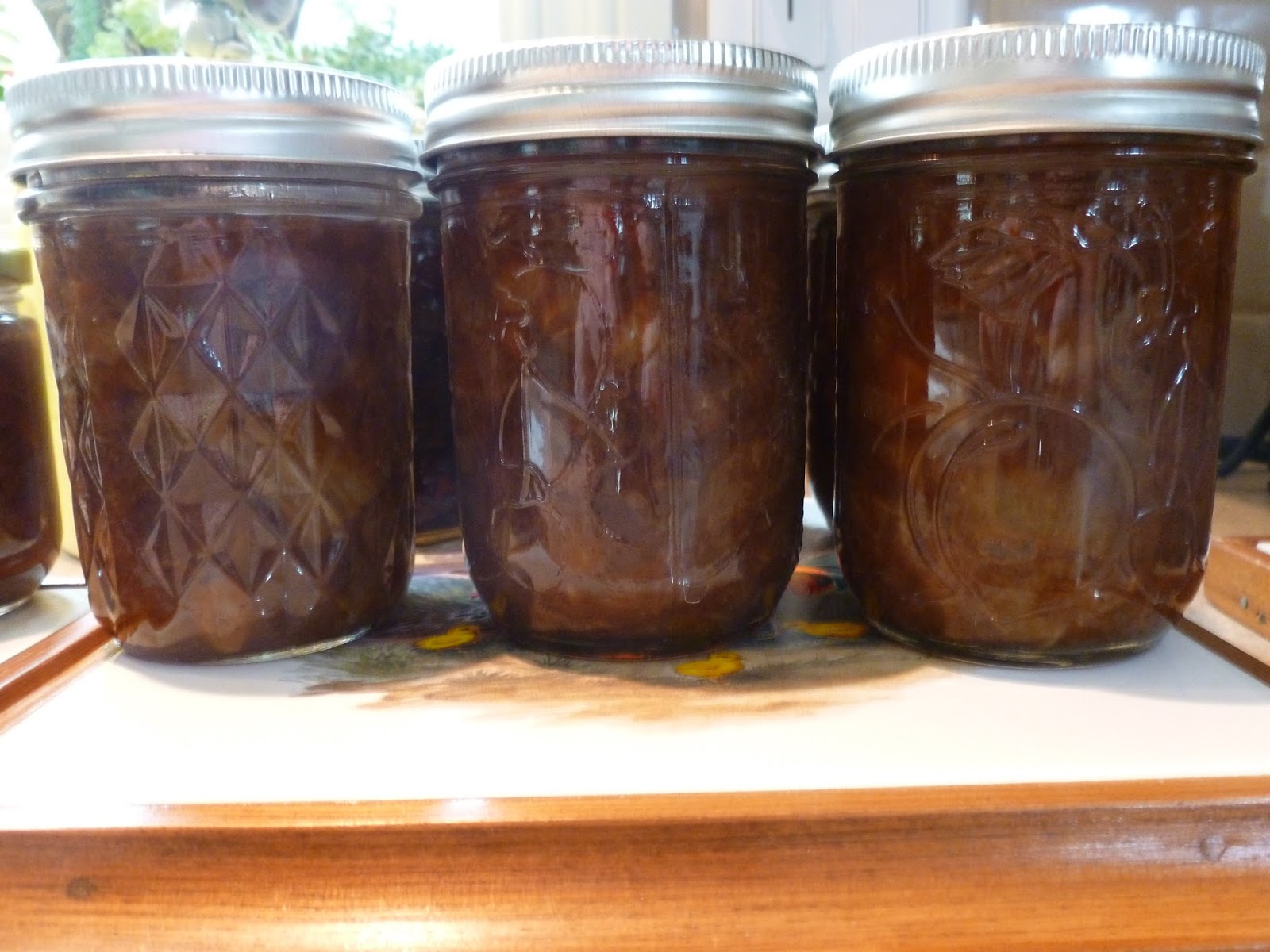
Jars of rhubarb relish for the months ahead.


After filling the jars to store on the cold room shelves, we have some relish left and sample with bread and cheese for lunch – delicious.

Our relish is great with bread and cheese.


Rhubarb has been valued as an early fruit on the Canadian prairies since the start of European settlement. Ours has been harvested from our late mother’s garden, increasing its value to us. 


Rhubarb is ready for harvest in the spring. 


Thursday, 4 June 2015

Trekking on


Vulcan, Alberta has unique tourist information signs. 

Travelling from the Edmonton area to Southern Alberta I often make a stop in the prairie town of Vulcan, just an hour from my usual destination of Lethbridge. In Vulcan I visit the Tourism and Trek Station near the highway. 

Vulcan's Tourism and Trek Station.

Visitors from all across North America and numerous more distant countries have signed the guest book at the Station, developed on the Star Trek theme. Even years ago we would stop at the town’s model of the Starship Enterprise. 

Vulcan's Starship Enterprise model. 

I have enjoyed Star Trek since my children were young. In fact my younger son heard plenty of Star Trek episodes while in utero.

A drive through Vulcan shows a prosperous community, apparently a turn-around accomplished largely through a marketing campaign based on its name coinciding with that of a fictional planet from the Star Trek televison and movie series.

Roddenberry memorial at Tourism and Trek Station.

Vulcan was the Roman name of the god of fire, first described in Greek mythology. The Alberta town was named by a Canadian Pacific Railway surveyor. The most famous citizen of the planet Vulcan is, of course, Spock, played by actor Leonard Nimoy.

Poster from 2010 visit of actor Leonard Nimoy.

Last month on my latest stop I also saw, for the first time, the town’s bust of actor Leonard Nimoy in his role as Spock. Other visitors had left candles and small stones acknowledging the actor’s death on February 27, 2015.


Bust of late actor Leonard Nimoy as the Vulcan Spock. 

I will leave you with Nimoy’s widely reported, last tweet, from shortly before his passing: “A life is like a garden. Perfect moments can be had, but not preserved, except in memory. Live Long and Prosper.” 

Live long and prosper.